This article reflects the perspective of Alex Barron, CEO of Ledger Series Media, shaped by ongoing conversations with global procurement, technology and leadership teams.
Where It Started
For most of my career, I’ve been obsessed with one thing.
People.
Not in a generic sense, but in a practical, instinctive way. Understanding how people think, how they learn, how they perform, and how they come together as a team.
That didn’t just come from work.
Understanding people and their actions has always been part of me. Even going back to studying sociology, I’ve always been drawn to looking beyond what someone does and instead trying to understand why they do it.
Not reacting to behaviour, but analysing it.
Looking past the surface and asking what’s really driving it.
That way of thinking has followed me through everything I’ve done.
That started early for me in Training & Development.
One of the first things you realise in that environment is that people don’t all learn the same way. Some need to see it, some need to do it, some need structure, some need space. And when you try to treat everyone the same, you get inconsistent results.
Not because people don’t want to perform, but because they haven’t been enabled in the right way.
Most people want to do well. Very few people come into work trying to fail or disrupt things. When performance isn’t there, it’s rarely a willingness problem.
It’s a clarity problem.
It’s a leadership problem.
I’ve heard the phrase many times in business, “round peg in a square hole”.
In my experience, that’s often an easy label.
More often than not, the person isn’t the problem. They just haven’t been shown clearly what good looks like, or supported in a way that allows them to get there.
From People to Teams
As I moved further into operations, that thinking evolved.
It became less about individuals and more about groups. Bringing together people with different personalities, different ages, different nationalities, and different ways of working.
The goal was always the same.
Create cohesion.
Get people moving in the same direction.
Deliver results.
For a long time, I believed something quite simple.
If people get on, things work.
If teams communicate, things improve.
If everyone pulls in the same direction, the business moves forward.
The Reality Check
Recently, I’ve realised it’s not that simple.
Through my own experience, and through speaking with hundreds of CPOs, CIOs and senior leaders on a regular basis, I’ve started to see a much deeper layer to this.
Because the issue isn’t just people.
It’s how organisations are structured.
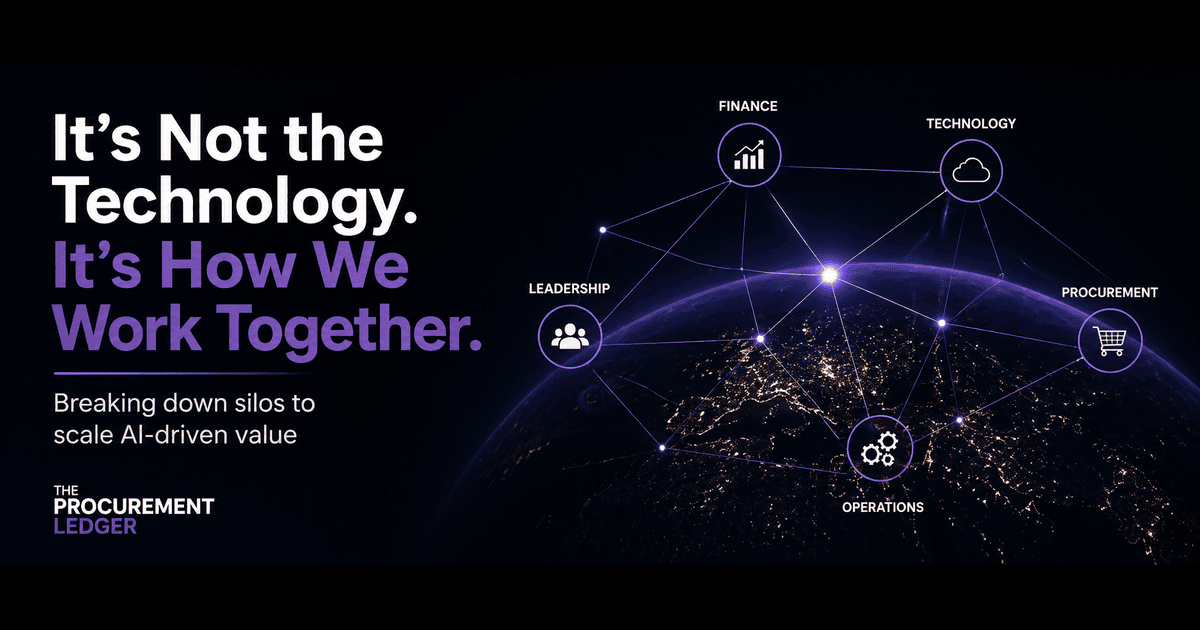
Every function in a business is operating with its own reality.
Finance are thinking about cost and risk.
Technology are thinking about implementation, integration and stability.
Procurement are thinking about value, suppliers and delivery.
Operations are thinking about execution and disruption.
Leadership are thinking about outcomes and accountability.
None of them are wrong.
In fact, they’re all right.
But they’re right from their own perspective.
That’s something I’ve always tried to do at an individual level, understand the reason behind behaviour rather than react to it. What I’m seeing now is that the exact same principle applies at a departmental and organisational level.
And that’s where the friction begins.
From the outside, it looks like resistance.
Finance blocking.
Tech slowing things down.
Procurement pushing too hard.
But when you look closer, it’s not resistance for the sake of it.
It’s responsibility.
It’s pressure.
It’s risk.
Why “Why” Matters
This is where something I read years ago from Simon Sinek came back to me.
“People don’t buy what you do, they buy why you do it.”
At the time, I saw that as a leadership concept.
Now I see it inside organisations.
If people don’t understand the why, they default back to protecting their own function.
They protect their budget.
They protect their systems.
They protect their responsibilities.
And that’s when silos form.
Where It Works
Some organisations understand this well.
Take Google as an example.
A big part of their success has been clarity of mission. People understand what they are working towards and why it matters.
That clarity doesn’t remove complexity.
But it creates alignment.
And when alignment exists, departments don’t just operate in isolation. They operate towards a shared outcome.
Now Add AI Into the Equation
I saw a post recently that summed it up perfectly.
AI investment is accelerating, but value is much harder to scale when teams are still operating in silos.
And that’s exactly it.
Because the technology isn’t the hard part anymore.
The hard part is getting organisations to actually work together in a way that allows that technology to deliver value.
Even in my own business, I’m knee deep in the move towards agentic AI and building it into how we operate.
And that’s in a small, founder-led environment where decisions can move quickly, systems are easier to change, and there is one clear direction.
Even then, it’s challenging.
Because it’s not just about plugging in new technology. It’s about changing how people think, how teams operate, and how decisions get made.
You’re not just introducing AI.
You’re asking organisations to rethink how they work.
To move faster.
To collaborate more.
To trust different processes.
And unless the underlying concerns of each function are understood, AI doesn’t unlock value.
AI doesn’t unlock value. It creates friction.
The Realisation
This is where it all clicked for me.
Everything I’ve done, understanding people, developing individuals, building teams, and driving cohesion, sits right on top of one of the biggest challenges businesses are facing today.
Not just getting people to perform.
But getting entire organisations to work together effectively.
Why This Study Matters
This is exactly why the work being done by the Lean Agile Procurement Alliance and World Commerce & Contracting matters.
But for me, this isn’t just something I’ve read about.
It clicked properly when I was in conversation with the team.
What stood out straight away was how aligned we were in thinking, even though we’ve come from completely different backgrounds.
They live and breathe procurement, contracting and transformation at scale.
I come from a background of understanding people, operations and how to bring teams together.
Yet we were describing the exact same problem, just from different angles.
That was the moment it landed.
We weren’t talking theory. We were describing the same reality.
Because what they are seeing across global organisations, I’ve experienced on the ground at a human level.
The same friction.
The same misalignment.
The same breakdown between teams.
Just at different scales.
That’s what makes this study important.
This isn’t another survey.
This global study is exploring how organisations are breaking down silos across procurement, legal, finance, supply chain and leadership to scale AI-driven value in practice.
It’s about uncovering:
Where things actually break.
Where alignment fails.
Where concerns sit.
Where transformation slows down.
Because once you understand that properly, you can start to fix it properly.
My Why
For me, this has been an important moment.
I’ve always been passionate about people.
Helping individuals perform.
Helping teams come together.
Creating better environments to work in.
What I’ve realised is that this doesn’t just sit at a team level.
It sits at an organisational level.
And in a way, that’s where my “why” has been the whole time.
Giving Back Starts Now
I used to think giving back was something you do later.
Once you’ve built enough.
Once you’ve made it.
But I can now see that it doesn’t have to wait.
You don’t need to wait.
If you can help people work better, feel heard, and operate in better environments, that is giving back.
To Sum It Up
This isn’t just about procurement.
It’s not just about technology.
It’s about people.
It’s about purpose.
And it’s about building organisations that actually work.
If you’re part of this space, your perspective genuinely matters.
👉 Take part in the study here: Have your say
👉 and book a conversation with me: Lets talk